
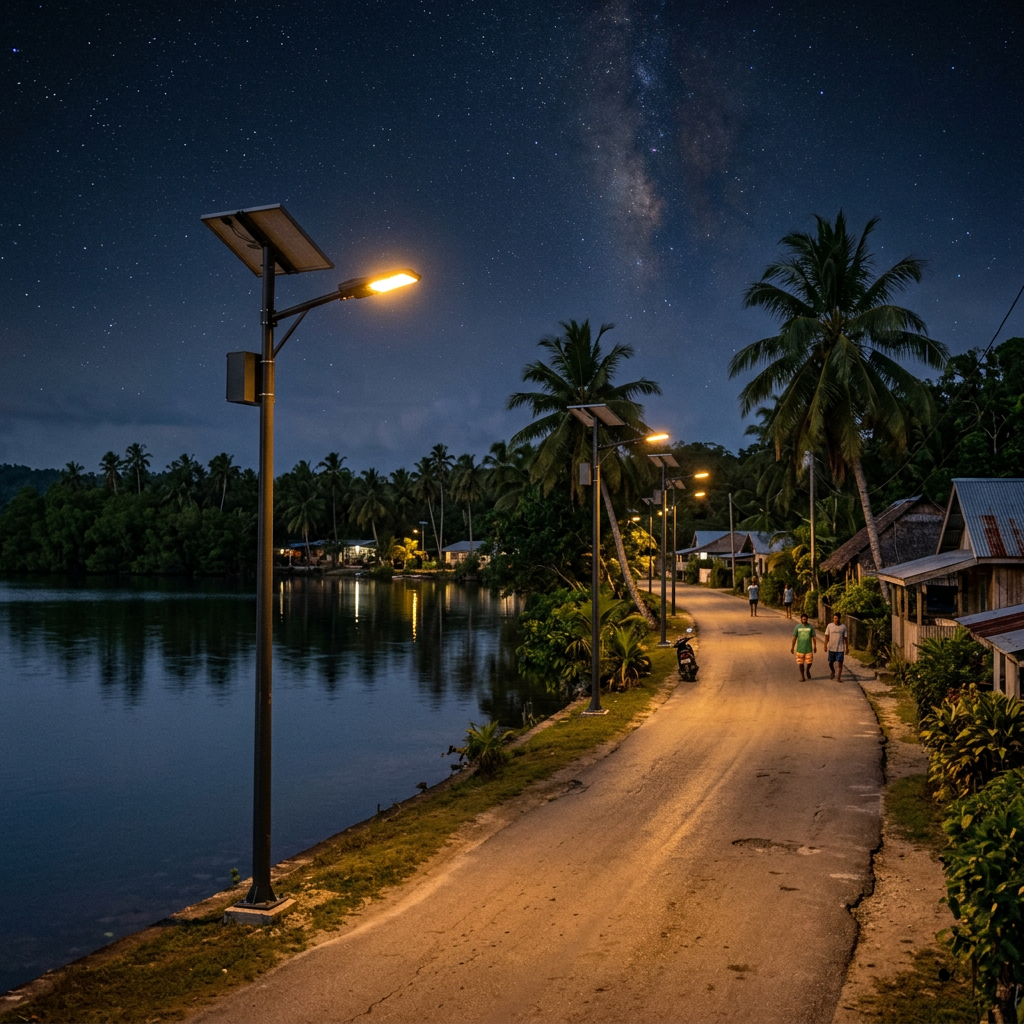
Street lighting improves safety, extends the working day and is something every resident sees. Self-contained solar lights, with the panel, battery and LED on the pole, avoid trenching and grid connections, which makes them ideal for island towns with expensive power. They also concentrate every island hazard into one product on a pole by the sea.
The luminaire
- Ingress protection: IP66 or better for the light and battery housing, to keep out driven rain and salt spray.
- Impact protection: IK08 or better.
- Warm colour: 3000 K or warmer. It reduces glare and sky glow, and warmer light is gentler on wildlife. On islands with turtle-nesting beaches, use amber or long-wavelength lighting near the shore.
- Smart dimming: full brightness in the early evening, dimmed in the small hours, with motion sensing where it suits. This stretches battery life considerably.
The battery
- LFP (lithium iron phosphate) chemistry, for heat tolerance and cycle life.
- At least three nights of autonomy, so a run of rainy days does not mean dark streets.
- A battery that can be replaced without replacing the whole light.
The pole and footing
- Hot-dip galvanized steel, with a coating suited to marine exposure.
- Pole, bracket and foundation designed for the local design wind speed, including the extra wind load of the solar panel.
- Stainless steel fixings, and a sealed base that does not trap water.
Installation and support
- Orient panels for the near-equatorial sun, and keep them clear of shade from trees and buildings.
- Train local crews to install, clean and service the lights, and leave them the tools.
- Order 5 to 10% spare units and components with the first shipment.
- Agree a warranty that the supplier can actually honour on island, and keep the warranty paperwork somewhere that will survive a flood.
The cheapest light on a price list is often the most expensive light on the street. Compare the cost per working year, not the cost per pole.